From Unstructured Chaos to Intelligent Automation

The largest health systems are working with Luminai to reimagine healthcare operations from the ground up.

Why Healthcare Automation Has Stalled
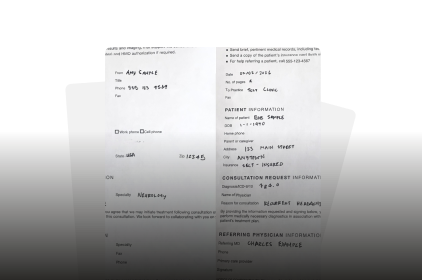
Unstructured by Default

80% of health system data lives in faxes, PDFs, chart notes, and the heads of experienced staff. Extraction isn't enough. It must be structured, encoded, and made usable for what comes next.
Siloed by Design

A single process can touch 5+ departments and 10+ systems. No "one" team or system owns the end-to-end outcome. Humans stitch the gaps.
Exceptions as Rules

Edge cases are the norm in today's world. This creates multi-branch workflows. Automation that can't intelligently route and manage exceptions often creates more work.
Incumbent Blind Spot

Workflows start and end outside the EHR, but they only automate what happens inside their 4 walls. The result is that no one owns the end-to-end process. The steps outside the EHR stay manual.

The Luminai Engine

Luminai handles the full lifecycle end-to-end: from unstructured input to completed actions

Ingestreceive unstructured inputs from any source
Structuretransform into actionable, downstream-ready data
Connectinterface with multiple EHRs, portals, and internal systems
Executeperform multi-step actions across applications
Enforceapply SOPs, compliance rules, and decision logic consistently
Escalateroute true exceptions with full context to humans
Closecomplete actions, update systems, trigger downstream workflows

We integrate seamlessly with any EHR, working alongside your existing systems with no replacements required

Solution in Practice: Orders and Referrals Processing

Luminai processes all faxed orders / referrals in near real-time to improve patient access and capture revenue

Fax Referral IntakeIngest documents and run Luminai models to parse clinical details and classify document type.
Patient & Provider VerificationQuery the EHR to confirm the patient and provider exist in the system. Flag mismatches or missing records for human triage.
Order TranscriptionDetermine the correct order or referral type and transcribe structured data directly into the EMR.
Insurance VerificationVerify the patient is in-network and confirm that the requested services are covered.
Clinical TriagePrioritize high-risk patients and flag missing information before it stalls downstream.
SchedulingReach out to the patient via preferred communication channel to get them scheduled for a visit.
Pre-Visit PrepRe-verify insurance, check patient out-of-pocket costs, and complete chart prepping.
Closed-Loop CommunicationClose the loop with the referring provider with a status update for the patient.